Ask three different people in Modesto, CA which CPR certification they need, and you will likely get three different answers, because the correct choice depends on who you treat and what your role requires. A nursing student heading into clinical rotations, an ER nurse managing adult cardiac arrests, and a pediatric unit nurse are not looking for the same course, even though all three searches start with the same question. This guide walks through how to match your specific situation to BLS, ACLS, or PALS so you register for the right one the first time.
Key takeaway: BLS CPR certification is the entry-level course nearly all healthcare workers need first, since it covers foundational CPR and AED skills for adult, child, and infant patients. ACLS and PALS both build on BLS and apply to more specific situations: ACLS for adult cardiac emergencies and PALS for infants and children. Your patient population, not your job title alone, is what determines which advanced course applies to you.
What Actually Determines Your Certification
The certification you need comes down to two factors: whether your role involves direct patient care, and which patients you are most likely to treat during a cardiac or respiratory emergency. A medical assistant in a family practice office has different needs than a paramedic responding to 911 calls, even though both work in healthcare.
Job titles alone can be misleading, since two nurses with the same title on different units may need different certifications. The clearest way to confirm what applies to you is to check your employer’s requirement or your nursing program’s clinical prerequisites rather than assuming based on a coworker’s certifications.
If You’re New to Healthcare or Entering Clinical Training
If you are a nursing student, new medical assistant, dental hygienist, or entering any allied health role for the first time, BLS is almost certainly your starting point. Basic Life Support covers high-quality CPR, AED use, choking relief, and team-based resuscitation for adult, child, and infant patients, and it functions as the prerequisite most advanced courses build on.
Modesto Junior College nursing students and other Stanislaus County healthcare trainees typically need an active BLS card before beginning clinical rotations, since hospitals and clinical sites require proof of current CPR competency before allowing student contact with patients. Confirm your program’s submission deadline, since clinical placement offices often require the card well before your first rotation date.
If Adult Cardiac Emergencies Are Part of Your Role
Advanced Cardiovascular Life Support (ACLS) applies once your position involves managing or directing the response to adult cardiac arrest, stroke, or acute cardiovascular events. This course adds cardiac rhythm recognition, medication protocols, and advanced airway management on top of the BLS foundation.
Emergency department nurses, ICU staff, cardiac catheterization lab teams, and physicians who lead resuscitation efforts typically need ACLS specifically. If your unit occasionally responds to adult emergencies but is not the primary team managing them, ask your manager whether ACLS is required for your position or reserved for a smaller response team.
If Your Patients Are Infants or Children
Pediatric Advanced Life Support (PALS) is not a simplified version of ACLS. Children have different airway anatomy, different medication dosing needs, and different physiological responses to shock and respiratory distress, so PALS trains providers specifically for those differences.
Pediatric nursing, school nursing, NICU and PICU roles, and EMS providers who regularly transport pediatric patients commonly require PALS. Some roles, such as general emergency departments that treat both adults and children, may require both ACLS and PALS since the patient population spans both age groups.
When You Might Need More Than One Certification
It is common, not unusual, for a single healthcare worker to hold BLS along with both ACLS and PALS if their role spans multiple patient populations. A flight nurse or a general ED nurse are two examples where dual certification is often standard rather than exceptional.
If you are unsure whether your role calls for one advanced certification or both, review your position description or ask your department’s education coordinator. Taking both when only one is required wastes time and money, while missing a required certification can delay clinical clearance or a job start date.
What Happens During Class and Testing
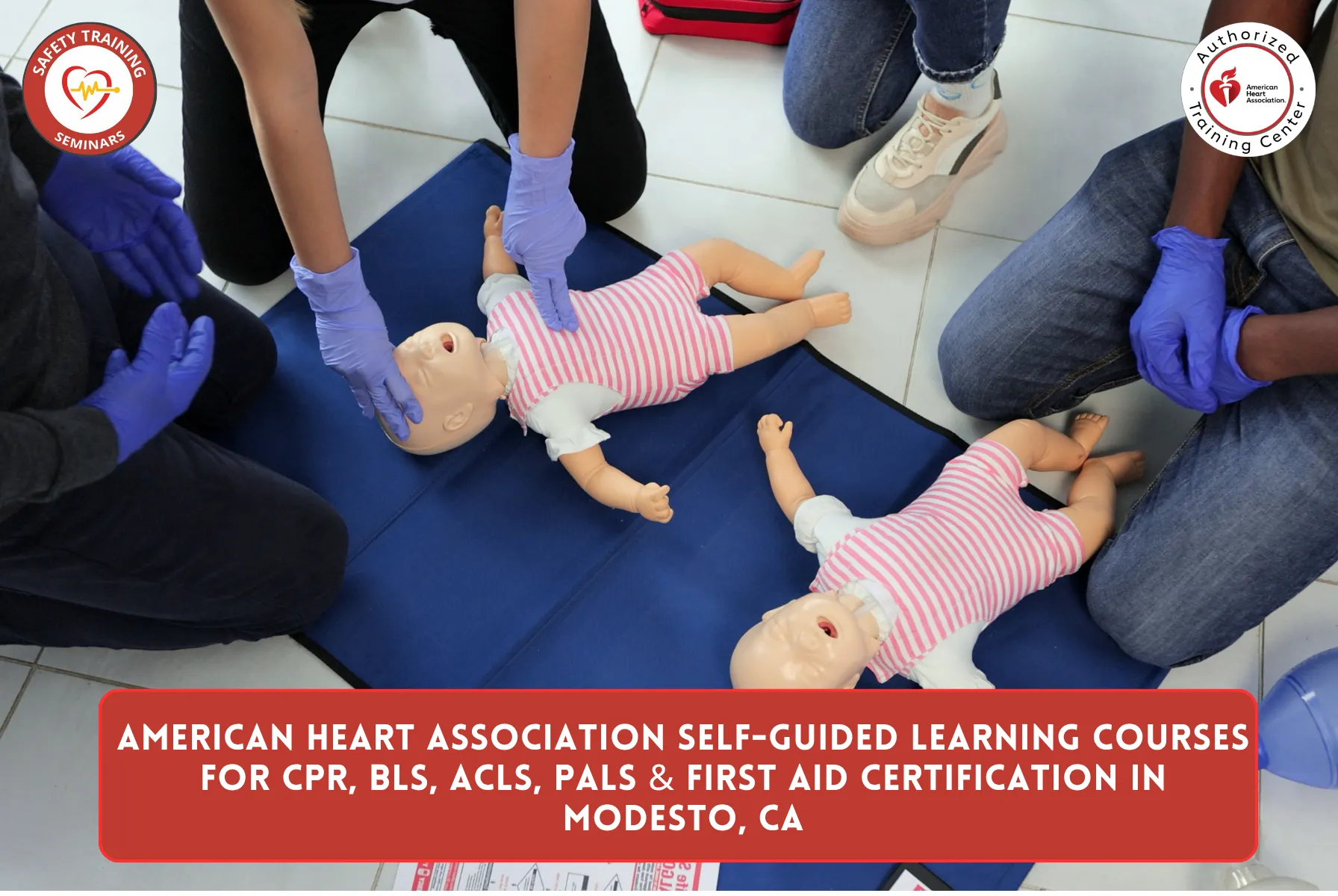
All three certifications combine instructional content with hands-on skills practice on a manikin, since competency is demonstrated through performance, not just a written exam. Many training providers offer a blended format, where the cognitive portion is completed online before an in-person skills session confirms your technique. If your employer or school specifies a particular format, confirm that before you register so the certification you complete is accepted without needing to repeat any portion of the course.
Certification Needs Across Modesto and Stanislaus County
Modesto serves as a regional hub for healthcare training across Stanislaus County, drawing nursing students and healthcare staff from Turlock, Oakdale, and surrounding communities who commute in for clinical programs and hospital-based work. Because BLS, ACLS, and PALS renewal deadlines rarely line up with a convenient class date, checking availability a few weeks ahead of your deadline is more reliable than waiting until your card is close to expiring.
Workplace teams in Modesto sometimes need a mix of certifications across a single department, particularly in clinics treating both adult and pediatric patients. If your schedule points you toward a class outside Modesto, reviewing BLS, ACLS, and PALS course options in Turlock or certification training available in Oakdale can help you compare what a nearby class looks like before you commit to a date.
Where to Confirm Course Details in Modesto
Safety Training Seminars operates a training center in Modesto, CA, at 706 13th Street, Suite A, Modesto, CA 95354, offering BLS, ACLS, and PALS courses along with CPR, First Aid, and NRP training. Reviewing course dates and format details before enrolling helps confirm the certification matches what your employer, clinical program, or licensing board requires.
Healthcare workers commuting from Patterson or Riverbank sometimes compare class schedules across more than one location. If that applies to you, CPR and BLS certification courses in Patterson or ACLS and PALS training options in Riverbank are worth reviewing alongside Modesto availability.
Frequently Asked Questions
Do I need to hold BLS before taking ACLS or PALS? Most training providers expect participants to already have working CPR skills consistent with BLS training before starting ACLS or PALS, since advanced material builds directly on that foundation. Some employers specifically require an active BLS card on file. Confirm your provider’s prerequisites and your employer’s policy before registering.
How do I know if my Modesto healthcare job requires ACLS, PALS, or both? This depends on which patients your role treats, not your job title alone. Emergency and ICU roles that manage both adult and pediatric emergencies often require both certifications, while unit-specific roles typically need only one. Ask your supervisor or education coordinator to confirm the exact requirement for your position.
Are online-only certifications accepted by Modesto employers? This varies by employer and training format. Many BLS, ACLS, and PALS courses use a blended model pairing online coursework with an in-person skills evaluation, since hands-on competency is generally assessed in person. Confirm with your employer whether a blended format satisfies their requirement.
Is training available for people commuting from Newman or Waterford? Yes, healthcare workers and students from smaller Stanislaus County communities including Newman and Waterford regularly commute to Modesto for certification training rather than searching separately in each town. Checking availability a few weeks ahead of your renewal deadline helps during busy clinical placement seasons.
What should I bring to a BLS, ACLS, or PALS course? Bring a government-issued photo ID and comfortable clothing for hands-on skills practice. If you are renewing a certification, bring your current card, since some courses use it to confirm your prior training level. Contact your training provider ahead of time to confirm any additional requirements.
Matching the Course to Your Role
Choosing between BLS, ACLS, and PALS comes down to identifying which patients your role requires you to respond to and at what level of intervention. BLS is the starting point for nearly every healthcare worker in Modesto, while ACLS and PALS apply once your position involves directing advanced care for adults or children specifically. Confirming the exact requirement with your employer or clinical program before you register is what prevents a delayed start date or a repeated class.
Safety Training Seminars’ Modesto location offers BLS, ACLS, and PALS courses for healthcare workers and nursing students throughout Stanislaus County. If you are ready to move forward, review current course availability and format details for Modesto, or compare a nearby location if your schedule points you elsewhere.