What the EMSA Preventive Health and Safety Course Is
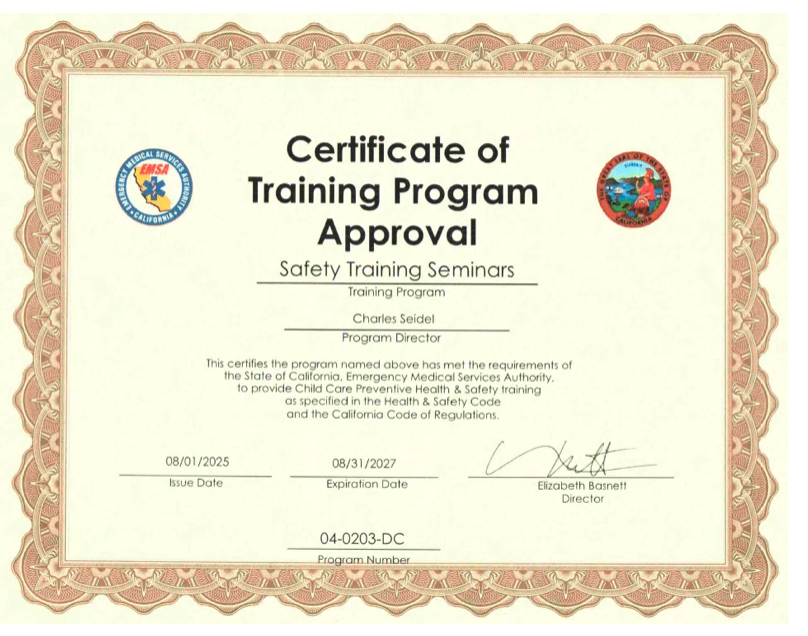
The California Emergency Medical Services Authority (EMSA) approves health and safety training for childcare providers in the state. Pediatric First Aid and CPR prepare a provider to respond after an injury or emergency. The Preventive Health Practices component prepares a provider to keep children healthy before a problem starts.
Preventive health is the everyday side of childcare: how food is prepared and served, how a diapering area is cleaned, how a classroom stays free of hazards, and how caregivers spot early signs that a child may need medical attention. Most of what keeps children safe in a care setting happens in these routine moments rather than during emergencies.
How the Training Fits California Childcare Licensing
In California, licensed childcare is overseen by Community Care Licensing, a division of the California Department of Social Services (CDSS). State law requires certain childcare personnel to complete EMSA-approved health and safety training. That training generally combines Pediatric First Aid, Pediatric CPR, and Preventive Health Practices.
Requirements are not the same for everyone. Who needs the training, and when, can depend on:
- Your role, such as licensee, director, or teacher
- Whether you work in a Family Child Care Home or a Child Care Center
- Your current licensing status or application stage
- Employer policies, which may go beyond state minimums
- Current regulations, which can change
Before registering, confirm your specific requirements with Community Care Licensing or your employer. This page offers general education, not legal or regulatory advice.
Topics Covered in Preventive Health Practices
EMSA-approved Preventive Health Practices training addresses the health conditions and environmental factors childcare providers deal with every day. Here is how the main subject areas apply in practice.
Environmental sanitation. Young children share toys, surfaces, and close contact all day, so germs spread quickly. Training covers cleaning and sanitizing routines for kitchens, toilets, diapering stations, and play areas. It also covers handwashing habits for children and adults and why indoor air quality matters in rooms where children nap and play.
Child health and illness prevention. Providers learn to recognize common childhood illnesses and to know when a child should stay home or see a doctor. They also learn how to reduce the spread of infection within a group.
Dental health. Tooth decay is common in early childhood. Childcare providers can support healthy habits through drink choices, snack choices, and age-appropriate oral care routines.
Lead Poisoning Prevention in Childcare Settings
Lead poisoning prevention is a required part of California’s preventive health curriculum for childcare providers. Young children are especially vulnerable to lead because they explore with their hands and mouths, and their developing bodies absorb lead more easily than adults do. Lead exposure can affect learning, behavior, and development, often without obvious early symptoms.
Locally, the Stanislaus County Childhood Lead Poisoning Prevention Program works to reduce lead exposure among children, raise awareness, and make sure children are appropriately tested. The county program notes that common lead sources include lead-based paint, dust, and contaminated soil.
For a Modesto childcare provider, that knowledge has practical uses. A home built before 1978 may contain lead-based paint, and peeling paint or dust near windows deserves attention. Outdoor play areas, imported toys, and certain household products can also be exposure sources. Stanislaus County’s program also tracks recalls and product warnings involving items with high lead levels, which is a useful resource for providers who buy toys and supplies.
Nutrition and Feeding Concerns in Early Childhood
Nutrition is one of the most hands-on parts of preventive health training. Many Modesto providers serve meals and snacks every day. That makes food choices, portion sizes, and feeding practices a regular responsibility.
Childcare professionals commonly encounter:
- Food allergies. These require careful label reading, clear communication with families, and steps to prevent cross-contact in the kitchen.
- Specialized diets. These may stem from medical needs, cultural traditions, or family preferences, and they need consistent handling across staff.
- Diabetes-related considerations. Children with diabetes may need structured meal timing and close coordination with parents and healthcare providers.
- Feeding and growth concerns. Picky eating, swallowing difficulties, or growth issues may need to be noted and shared with families.
- Age-appropriate meal planning. Infants, toddlers, and preschoolers each have different textures, portions, and choking-risk considerations.
The training gives providers a practical framework for these situations. It does not replace guidance from a child’s physician or a registered dietitian.
Modesto’s Childcare and Early Education Community
Modesto has an active early childhood education network, which is part of why local preventive health training is in steady demand.
Modesto City Schools offers free and sliding-fee Early Childhood Education programs, and each includes child health and nutrition components. The district works with licensed Family Child Care Homes as well. Six licensed Family Child Care Homes in the Modesto area provide Early Head Start/Child Care Partnership services for children from 2 months through 3 years. The district’s Head Start program operates as a delegate under the Stanislaus County Office of Education.
Students also enter the field through Modesto Junior College, which offers child development coursework and certificates. The college’s main campus is at 435 College Avenue, with a branch campus in West Modesto. Students preparing for licensed childcare work may want to plan their health and safety training alongside their coursework. They should check with their program or future employer about what is expected.
Who in the Modesto Area May Benefit
The EMSA Preventive Health and Safety Course may be useful for:
- People applying for or renewing a Family Child Care Home license in Stanislaus County
- Teachers, aides, and directors at Modesto Child Care Centers and preschools
- Early childhood education students preparing to enter licensed care
- Staff in early learning programs where employers ask for EMSA training
- Nannies and in-home caregivers who want stronger preventive health knowledge
Parents and other caregivers who are not subject to licensing may also find the material useful, especially the nutrition and lead prevention content.
Training Access From Ceres, Salida, Riverbank, and Nearby Communities
The Modesto center sits in the downtown area and is reachable from many parts of Stanislaus County. Childcare professionals from Modesto, Ceres, Salida, Riverbank, Empire, Oakdale, Waterford, and Turlock may consider this location when searching for EMSA training near Modesto.
Highway 99 links Modesto with Ceres, Salida, and Turlock. Highway 132 connects central Modesto with Waterford and the east side of the county. Providers in neighboring San Joaquin County communities such as Ripon and Escalon may also find Modesto a workable option, depending on where they live and work.
Safety Training Seminars in Modesto
Safety Training Seminars offers childcare and emergency training at its Modesto location: 706 13th Street, Suite A, Modesto, CA 95354
Along with the EMSA Health and Safety course, the Modesto center offers CPR, First Aid, BLS, and other American Heart Association courses. Childcare providers who also need Pediatric CPR and First Aid can look for related options at the same location. Course schedules, formats, and registration details are listed on the Safety Training Seminars Modesto training page.
Before You Register
A few steps can save time:
- Confirm which training your role requires with Community Care Licensing or your employer.
- Check whether you also need Pediatric CPR and First Aid, and plan both together if so.
- Review current class dates, pricing, and course details on the registration page, since availability changes.
- Keep your completion records, because licensing staff or employers may ask to see them.
Getting Started With Preventive Health Training in Modesto
Preventive health knowledge shapes the daily work of childcare. It guides how meals are planned, how a diapering station is cleaned, and how a provider responds to peeling paint in an older home. For Modesto providers working toward an EMSA Childcare Health & Safety Certification, local training in Stanislaus County makes it easier to meet licensing expectations and bring practical skills back to the children in their care.
Confirm your requirements, then visit the Safety Training Seminars Modesto page to find the EMSA Preventive Health and Safety class that fits your schedule.